May 2026
10 minutes
Case Study: Vault Bridge Tapped Cork to Pioneer Productive Approach to Liquidity Reserves
How an external liquidity buffer replaced idle cash freed $5M for deployment and delivered yield for depositors through two live stress events.
Overview
Agglayer's VaultBridge earns yield for its users by deploying bridged funds into Morpho lending markets on Ethereum. When users bridge USDC to Katana, they receive the vbUSDC yield-bearing token. On the Ethereum side, their USDC is put to work in lending markets with average utilization rates of 86% via curated vaults.
Every protocol that deploys capital into lending markets faces the same structural question: how do you guarantee withdrawal liquidity without holding idle reserves that drag on yield? The conventional answer is an internal cash buffer where capital is set aside, earning nothing, so it can be available to absorb redemptions during a crunch. For VaultBridge, guaranteeing $5M of withdrawal capacity through an internal buffer would have meant $5M sitting idle for 91 days, or approximately $37.5K in foregone yield at the vault's 3.00% average APY.
Cork Protocol's external liquidity buffer offered a different answer where liquidity risk can be transferred to external underwriters, freeing the full $5M for deployment in Morpho vault strategies. The result was $37.5K in yield that would otherwise not have been earned while a liquidity buffer sustained depositor confidence across two real stress events.
Problem: The Hidden Cost of Keeping Capital Ready
Agglayer’s Vault Bridge is a yield-bearing bridge. The premise of a yield-bearing bridge is that rather than holding bridged assets idle, they can be deployed into productive strategies. For Vault Bridge, that means depositing USDC into Morpho lending markets, where borrowers pay interest and depositors earn yield.
However, capital earning yield in a lending market is, by definition, not simultaneously available for instant withdrawal. This is a liquidity risk that’s reflected in a market’s utilization rate. When utilization is high, most of the supplied liquidity is actively deployed to borrowers, therefore depositors face the risk of not being able to withdraw their funds in a timely manner.
Vault Bridge’s curated vaults allocate USDC across three Morpho markets that have the following utilization rates:
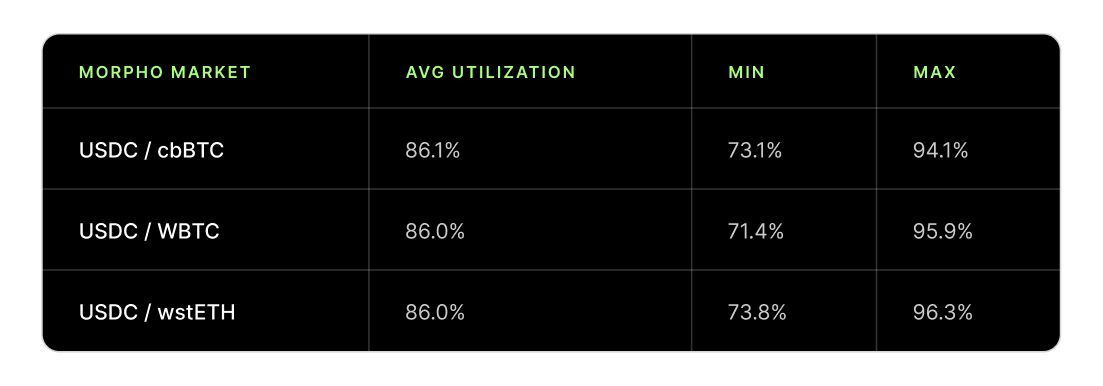
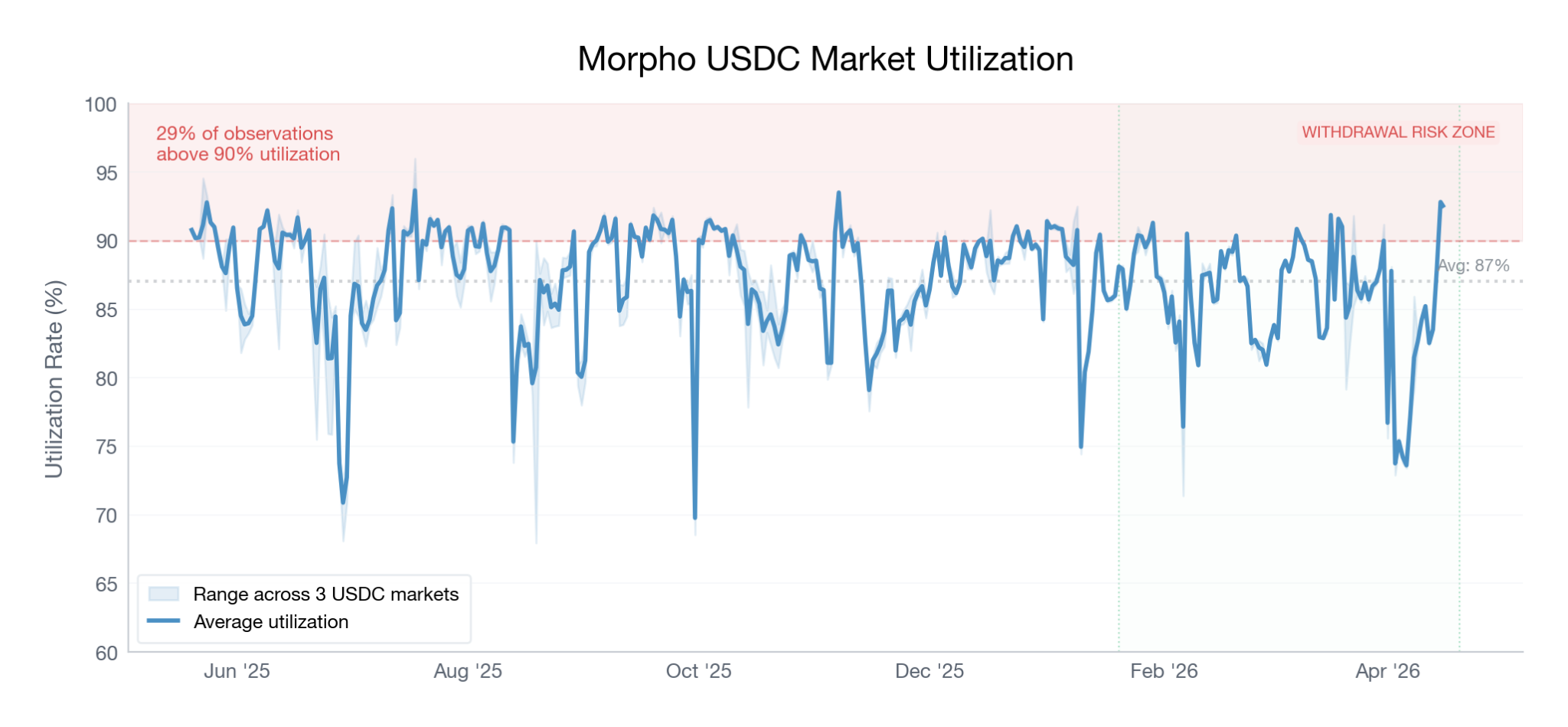
At 86% average utilization, 14% of the vault is available for instant redemption at any given moment. At 96.3% only 4% is available. For a $50M vault, that's $2M of immediate liquidity against any redemption demand that exceeds it.
The conventional solution is an internal cash buffer where a tranche of capital is held outside the lending markets, available to cover redemptions when utilization peaks. Protocols using this approach typically size buffers at 10% of TVL, or in Vault Bridge's case around $5M, to guarantee meaningful liquidity coverage. The problem is that every dollar in the internal buffer is a dollar not earning the vault's APY.
The industry has other responses, each with tradeoffs:
- Exit queues. Protocols can let users redeem after a wait period. This preserves yield but degrades user experience. Bridge integrations like Vault Bridge struggle here because the user-facing promise is usually around fast settlements and most users will be put off by the prospect of absorbing the loss during a stress event.
- Speed and agentic exit. Protocols can monitor lending markets with automated tooling and unwind positions fast when stress appears. This works for sophisticated operators with the right infrastructure. For any participant without that speed advantage, it is the mechanism by which loss is transferred to them silently.
None of these address the underlying issue. They simply redistribute the cost to yield, to UX, or to slower participants.
Solution: An External Liquidity Buffer That Unbundles Risk
Cork Protocol's external liquidity buffer is specifically designed for this tradeoff. It provides onchain markets where specific tail risks are priced, transferred, and owned by consenting counterparties. Instead of VaultBridge holding $5M in idle cash, Cork's underwriters hold collateral against that $5M of liquidity capacity and Vault Bridge pays a premium for the right to draw on it.
It works as follows:
- Liquidity providers deposit sUSDe collateral into a Cork Pool
- The protocol mints cPT (Cork Principal Token) and cST (Cork Swap Token) in equal ratio
- Vault Bridge purchases cST, which is the instrument that carries the right to exchange vbUSDC for sUSDe at face value
- If a liquidity crunch occurs, VaultBridge exercises cST: delivers vbUSDC, receives sUSDe, swaps to USDC, and serves withdrawals immediately, regardless of Morpho utilization
- If no exercise occurs, cST expires and the underwriters keep the premium
This decouples Vault Bridge's yield strategy from its redemption obligations, that way the $5M capital stays deployed in Morpho earning whatever the markets return. Meanwhile, the Cork liquidity buffer stands ready as a pre-priced exit, where underwriters are bearing the specific tail risk instead of Vault Bridge users.
How Agglayer used Cork
With the tail risk priced and transferred to Cork underwriters, Vault Bridge could operate with full capital deployment into Morpho without holding idle reserves or worrying users about exit-queue delays on the bridge:
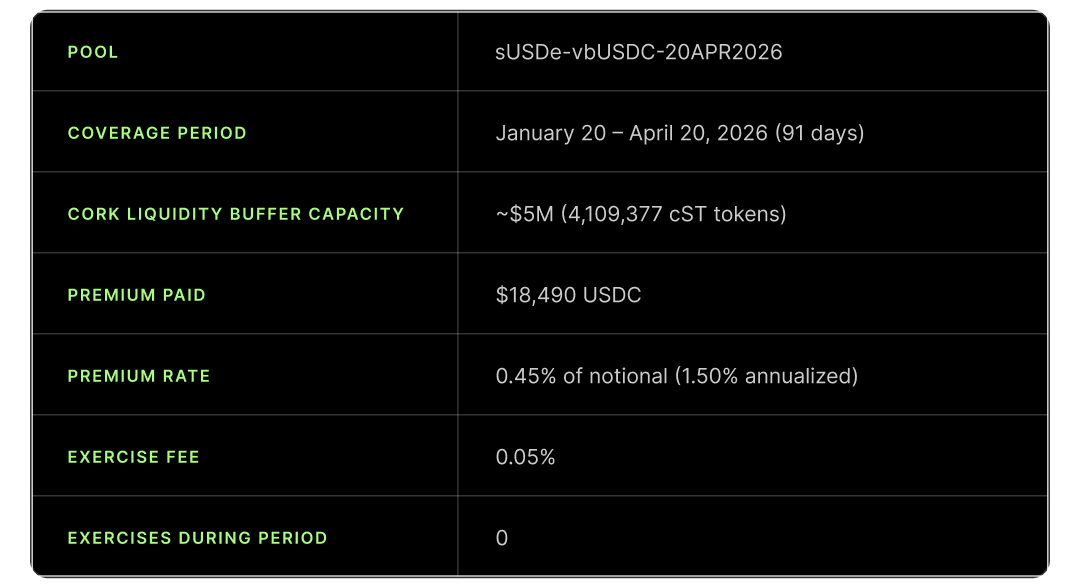
Cork’s liquidity buffer guaranteed depositors that up to $5M more in funds would be available in the event of a liquidity crisis where the utilization rate reached 100%. The only other way Vault Bridge would’ve been able to offer this reassurance to depositors would’ve been to hold that $5M, unproductively, in cash.
Results: Saving $37.5K in Foregone Yield
Over the 91-day coverage period, the USDC Morpho vault generated approximately $519K in gross yield with a 3% APY on average. Adjusted for Vault Bridge's weighted average share of the vault (~97%), approximately $503K is attributable to Vault Bridge-deposited capital.
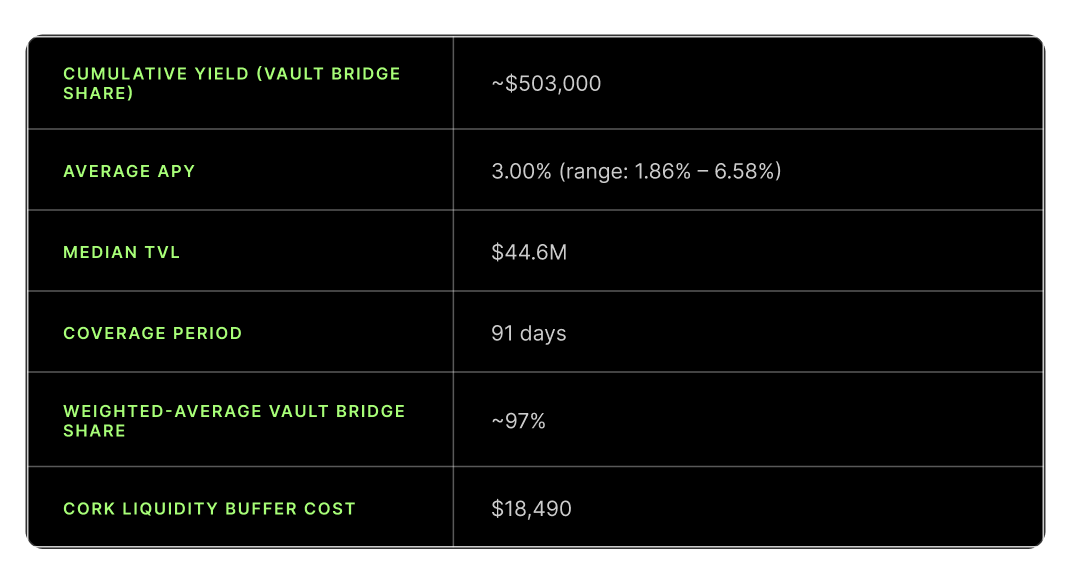
Out of that $503K, Cork’s external liquidity buffer facilitated approximately $37,500 in yield that would’ve been forgone if Vault Bridge had relied on a conventional cash reserve to guarantee the same $5M of withdrawal capacity.
$5M internal buffer × 3.00% APY × 91 days = ~$37.5K in foregone yield
The net yield advantage over a cash-buffer approach was approximately $19K, on a premium of $18,490. The buffer essentially paid for itself in terms of unlocked yield.
There’s also a qualitative takeaway. That advantage was preserved through two live stress events where depositor confidence in Vault Bridge’s ability to face a liquidity crunch was also put to the test:
Stress Event 1: KAT Token Campaign (March 3–18)
In early March, Katana launched campaigns on OKX and Binance for its KAT token. The inflow and subsequent exit produced Vault Bridge's largest TVL swings to date, creating a concentrated stress driven by Katana's own token event.
Inflow (March 3-5):
- $122M USDC deposited
- Total Vault Bridge TVL peaked at $618M
Outflow (March 16-18):
- $80M+ USDC withdrawn
- Total Vault Bridge TVL moved from $618M to approximately $217M within days
Vault Bridge was able to serve every redemption. The KAT cycle demonstrated the operational capacity of the Vault Bridge architecture under concentrated flow conditions.
Stress Event 2: Mid-April DeFi Contagion (April 18–19)
On April 18, an unrelated DeFi bridge exploit of approximately $292M became the largest incident of the year to that point. Over the following 48 hours, approximately $13B of total value locked left DeFi lending markets as participants pulled liquidity across major venues.
Several lending markets froze and one major protocol paused its L1 bridge module. Secondary-market prices on correlated collateral moved meaningfully below reference rates.
The stress surfaced at the Morpho layer of Vault Bridge's USDC position by peaking utilization rates.
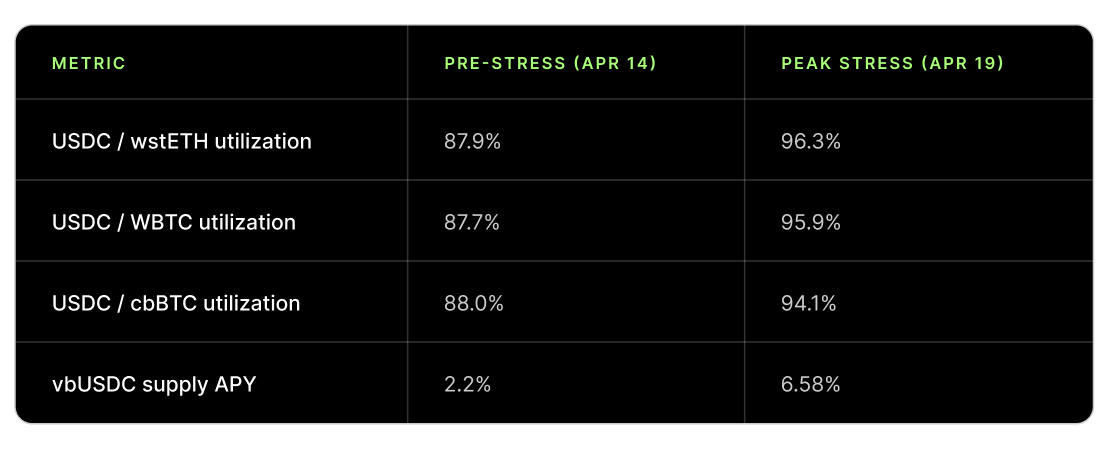
Cork's $5M external buffer stood ready as the next line of liquidity, providing more than double the $2M of liquidity that was withdrawable during the 96.3% peak.
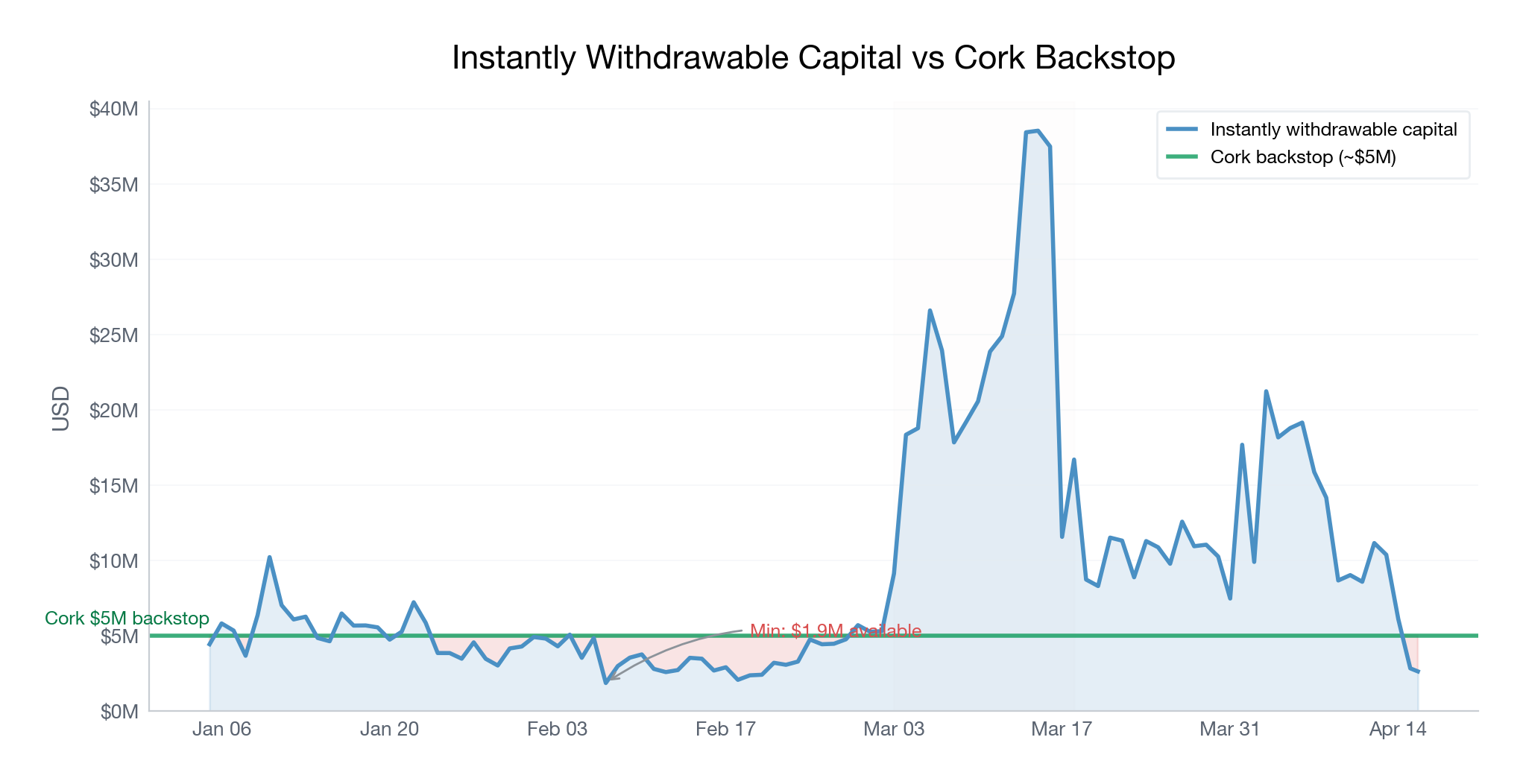
However, depositors reacted calmly and the buffer was not needed. The result was that vbUSDC saw approximately $5.4M of net inflows instead, while broader DeFi lending lost $13B.
The pattern across both events was the same. When users knew guaranteed liquidity existed, withdrawal pressure didn't build and there were no panic sales as a result. The buffer created a virtuous feedback loop where its existence reduced the likelihood it would ever need to be used in the first place.
Conclusion
VaultBridge's integration with Cork is a demonstration of what yield-bearing bridge infrastructure looks like when the liquidity tradeoff is properly priced rather than absorbed silently.
The conventional alternative of holding $5M in idle cash would have cost VaultBridge approximately $37.5K in foregone yield over the coverage period while delivering identical liquidity capacity. Cork's external buffer cost $18,490, freed the full $5M for deployment, and generated a net yield advantage of approximately $19K over a cash-reserve approach. The total depositor yield was $503K over 91 days, during which the integration was stress-tested twice and the buffer was never exercised.
Bridge to Katana productively using Agglayer’s Vault Bridge. Learn more about Cork’s liquidity buffer solution or contact us to see how it adapts to your vault strategy.